This project (GA n° [2242]) is part of the PRIMA programme supported by the European Union.

News & Articles

File Type: pdf

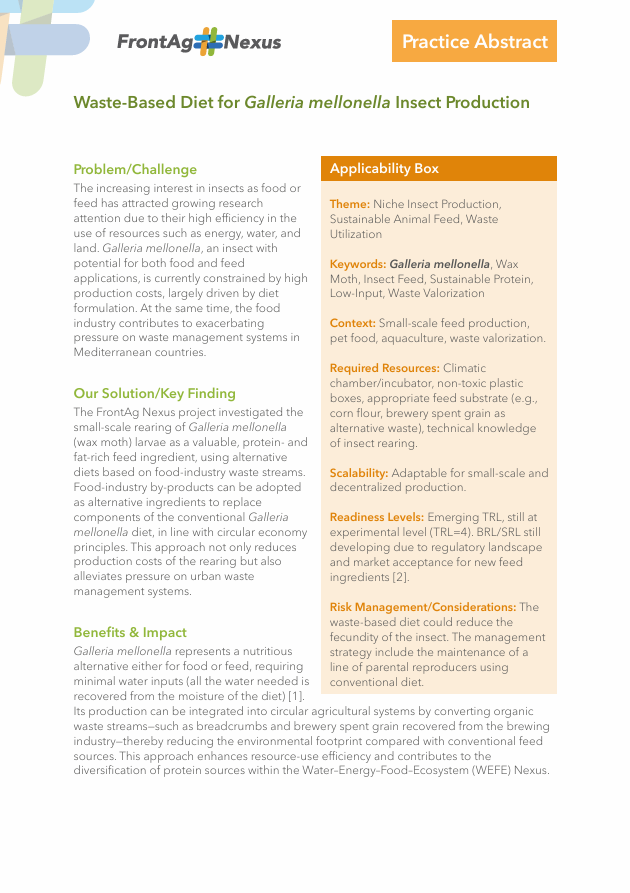
Waste-based diet for Galleria mellonella insect production

The use of insects as food for humans and as feed for livestock is increasingly acknowledged as a viable strategy to enhance food security while reducing environmental pressures. From a nutritional perspective, entomophagy is not a recent phenomenon but rather a long-standing practice in many cultures.

Aquaponics with fish sludge anaerobic digestion

Aquaponics is a sustainable agricultural practice that integrates aquaculture (fish farming) and hydroponics (growing plants without soil). This symbiotic system allows for the efficient production of both fish and plants, where the fish waste provides essential nutrients for plant growth, and the plants, in turn, help purify the water for the fish. However, while aquaponics offers numerous environmental and economic benefits, it also presents challenges, particularly in the management of fish sludge.

How to produce Galleria mellonella in a small-scale insect farm

Insect farming requires low production inputs therefore representing an important opportunity, given the prospect of a growing world population and a simultaneous reduction in available resources. In Europe, being a so-called “Novel Food” (Regulation (EU) 2015/2283), legislation to regulate the production and consumption of insects, both for human and animal diet, has been taking first steps in recent years. At this current stage, human and animal consumption of some insect species has been approved by the European Commission, opening to a promising future increase of consumption.

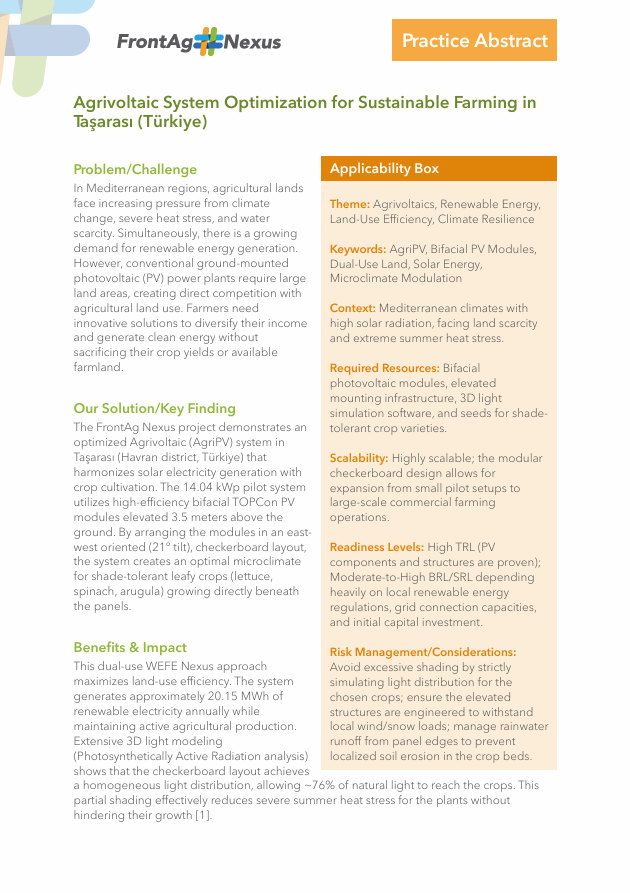
Agrivoltaic System Optimization for Sustainable Farming in Taşarası (Türkiye)

The FrontAg Nexus project demonstrates an optimized Agrivoltaic (AgriPV) system in Taşarası (Havran district, Türkiye) that harmonizes solar electricity generation with crop cultivation. The 14.04 kWp pilot system utilizes high-efficiency bifacial TOPCon PV modules elevated 3.5 meters above the ground. By arranging the modules in an east-west oriented (21° tilt), checkerboard layout, the system creates an optimal microclimate for shade-tolerant leafy crops (lettuce, spinach, arugula) growing directly beneath the panels.

Waste-Based Diet for Galleria mellonella Insect Production

The FrontAg Nexus project investigated the small-scale rearing of Galleria mellonella (wax moth) larvae as a valuable, protein- and fat-rich feed ingredient, using alternative diets based on food-industry waste streams. Food-industry by-products can be adopted as alternative ingredients to replace components of the conventional Galleria mellonella diet, in line with circular economy principles. This approach not only reduces production costs of the rearing but also alleviates pressure on urban waste management systems.

Navigating the Landscape: Policy & Readiness for Frontier Agriculture in the Mediterranean (WEFE Nexus Lens)

FrontAg Nexus research highlights that accelerating frontier agriculture adoption necessitates targeted policy interventions and a strategic approach to enhancing readiness levels. Coherent policy frameworks, specific incentives, and robust R&D support are crucial to bridge the gap between technical feasibility, business readiness, social readiness (TRL, BRL, SRL), and practical implementation.

Contact