This project (GA n° [2242]) is part of the PRIMA programme supported by the European Union.

News & Articles

Document Author: Francesco Orsini

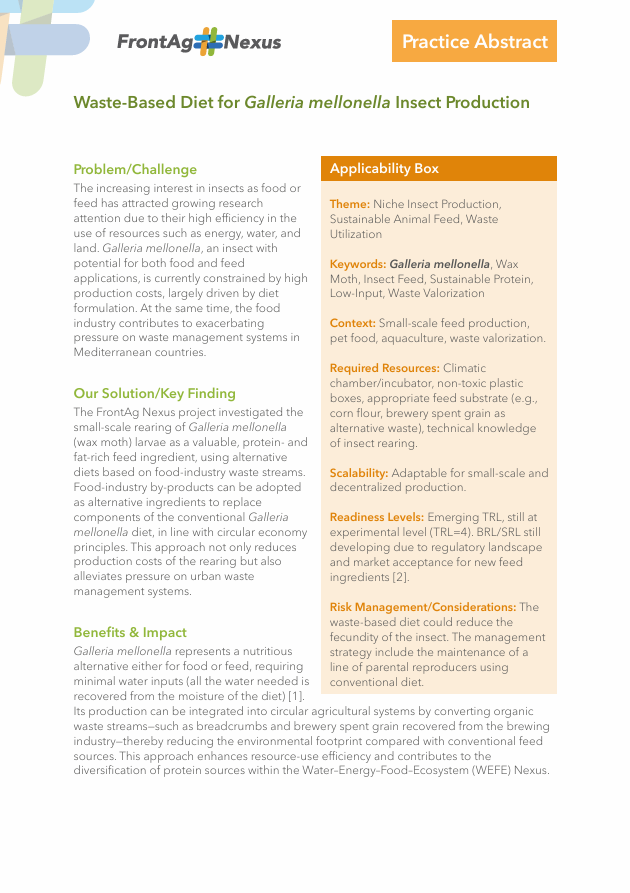
Waste-based diet for Galleria mellonella insect production

The use of insects as food for humans and as feed for livestock is increasingly acknowledged as a viable strategy to enhance food security while reducing environmental pressures. From a nutritional perspective, entomophagy is not a recent phenomenon but rather a long-standing practice in many cultures.

How to produce Galleria mellonella in a small-scale insect farm

Insect farming requires low production inputs therefore representing an important opportunity, given the prospect of a growing world population and a simultaneous reduction in available resources. In Europe, being a so-called “Novel Food” (Regulation (EU) 2015/2283), legislation to regulate the production and consumption of insects, both for human and animal diet, has been taking first steps in recent years. At this current stage, human and animal consumption of some insect species has been approved by the European Commission, opening to a promising future increase of consumption.

Waste-Based Diet for Galleria mellonella Insect Production

The FrontAg Nexus project investigated the small-scale rearing of Galleria mellonella (wax moth) larvae as a valuable, protein- and fat-rich feed ingredient, using alternative diets based on food-industry waste streams. Food-industry by-products can be adopted as alternative ingredients to replace components of the conventional Galleria mellonella diet, in line with circular economy principles. This approach not only reduces production costs of the rearing but also alleviates pressure on urban waste management systems.

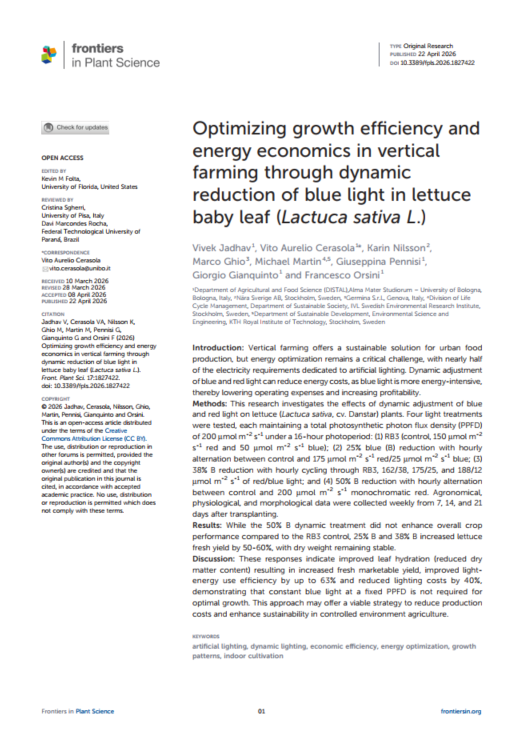
Optimizing growth efficiency and energy economics in vertical farming through dynamic reduction of blue light in lettuce baby leaf (Lactuca sativa L.)

Vertical farming offers a sustainable solution for urban food production, but energy optimization remains a critical challenge, with nearly half of the electricity requirements dedicated to artificial lighting. Dynamic adjustment of blue and red light can reduce energy costs, as blue light is more energy-intensive, thereby lowering operating expenses and increasing profitability.

Exploring dynamic nitrogen (N) fertigation guided by multispectral sensors: a sustainable optimization of N fertilization in processing tomato

Dynamic management of nitrogen (N) guided by multispectral sensors can help match in-season crop N requirements with precise N supply through fertigation. In the present work, different dynamic strategies to optimise N fertigation in processing tomatoes were explored in two plot experiments across two different years and locations, compared with a well-fertilised control (180 kg N ha-1, N180). In dynamic N strategies, the green vegetation index (GVI) was monitored with a hand-held multispectral radiometer.

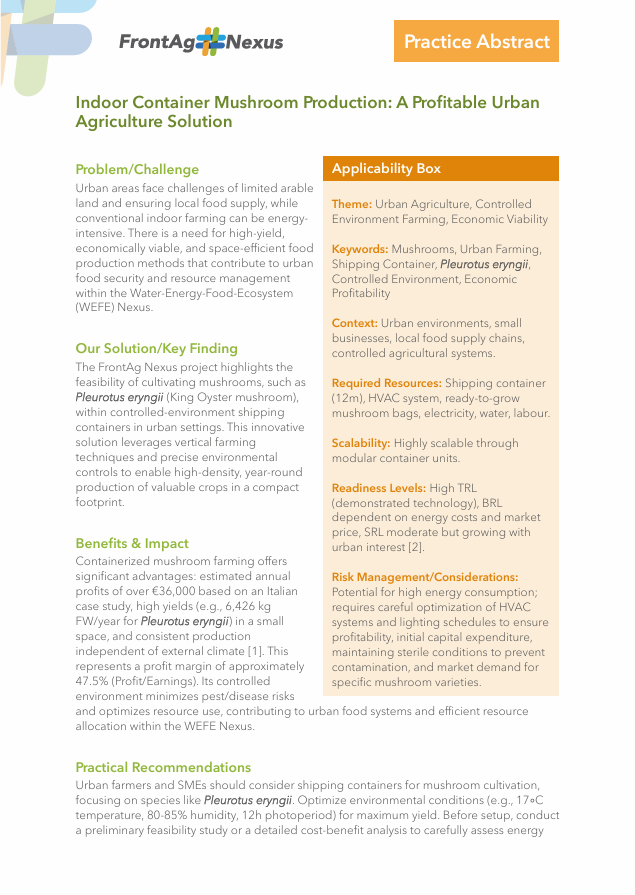
Practice Abstract: “How to produce mushrooms inside a shipping container in an urban environment”

Urban agriculture has long been identified as a valid solution to guarantee food security and the creation of small profitable businesses in developing and non-developing countries. As is known, the number of inhabitants in cities has recently exceeded the number of inhabitants in rural areas, resulting in an extension of the concrete surface and a greater distance from food supply areas.

Contact