This project (GA n° [2242]) is part of the PRIMA programme supported by the European Union.

News & Articles

Document Author: Vito Aurelio Cerasola

Waste-based diet for Galleria mellonella insect production

The use of insects as food for humans and as feed for livestock is increasingly acknowledged as a viable strategy to enhance food security while reducing environmental pressures. From a nutritional perspective, entomophagy is not a recent phenomenon but rather a long-standing practice in many cultures.
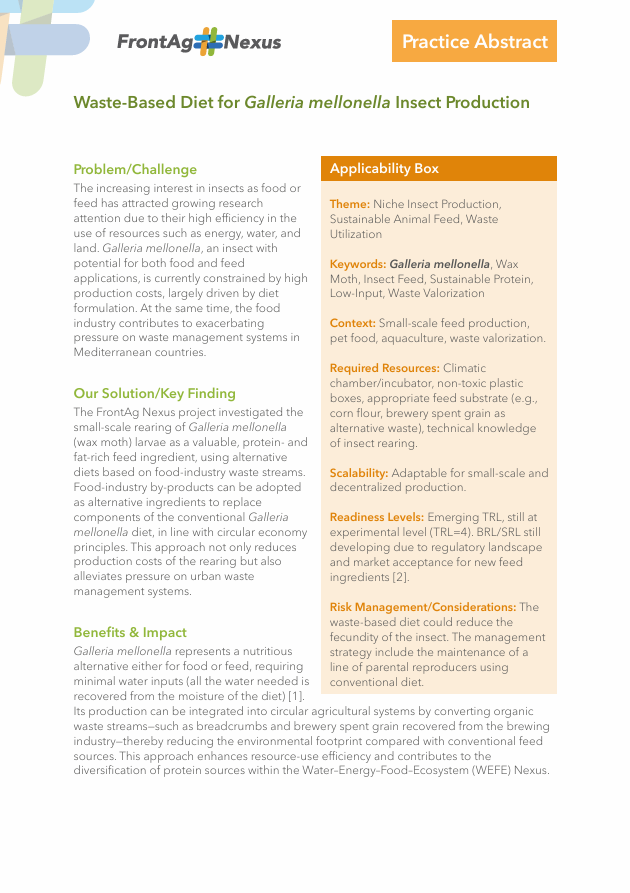
Waste-Based Diet for Galleria mellonella Insect Production

The FrontAg Nexus project investigated the small-scale rearing of Galleria mellonella (wax moth) larvae as a valuable, protein- and fat-rich feed ingredient, using alternative diets based on food-industry waste streams. Food-industry by-products can be adopted as alternative ingredients to replace components of the conventional Galleria mellonella diet, in line with circular economy principles. This approach not only reduces production costs of the rearing but also alleviates pressure on urban waste management systems.

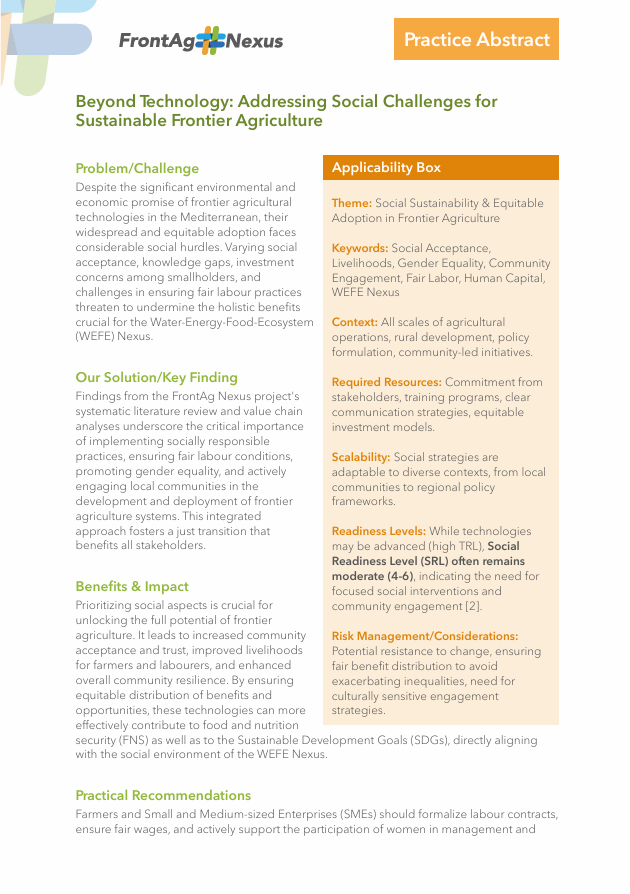
Beyond Technology: Addressing Social Challenges for Sustainable Frontier Agriculture

Findings from the FrontAg Nexus project’s systematic literature review and value chain analyses underscore the critical importance of implementing socially responsible practices, ensuring fair labour conditions, promoting gender equality, and actively engaging local communities in the development and deployment of frontier agriculture systems. This integrated approach fosters a just transition that benefits all stakeholders.

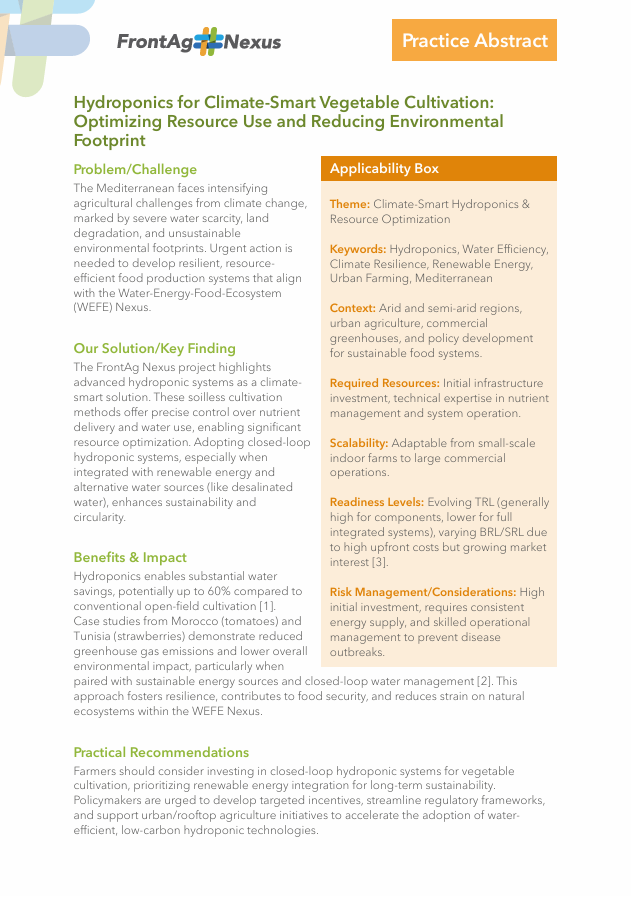
Hydroponics for Climate-Smart Vegetable Cultivation: Optimizing Resource Use and Reducing Environmental Footprint

The FrontAg Nexus project highlights advanced hydroponic systems as a climate-smart solution. These soilless cultivation methods offer precise control over nutrient delivery and water use, enabling significant resource optimization. Adopting closed-loop hydroponic systems, especially when integrated with renewable energy and alternative water sources (like desalinated water), enhances sustainability and circularity.

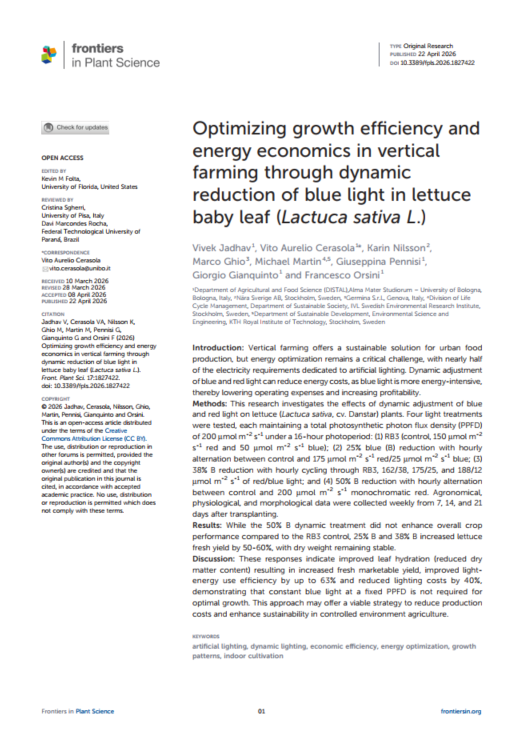
Optimizing growth efficiency and energy economics in vertical farming through dynamic reduction of blue light in lettuce baby leaf (Lactuca sativa L.)

Vertical farming offers a sustainable solution for urban food production, but energy optimization remains a critical challenge, with nearly half of the electricity requirements dedicated to artificial lighting. Dynamic adjustment of blue and red light can reduce energy costs, as blue light is more energy-intensive, thereby lowering operating expenses and increasing profitability.

Exploring dynamic nitrogen (N) fertigation guided by multispectral sensors: a sustainable optimization of N fertilization in processing tomato

Dynamic management of nitrogen (N) guided by multispectral sensors can help match in-season crop N requirements with precise N supply through fertigation. In the present work, different dynamic strategies to optimise N fertigation in processing tomatoes were explored in two plot experiments across two different years and locations, compared with a well-fertilised control (180 kg N ha-1, N180). In dynamic N strategies, the green vegetation index (GVI) was monitored with a hand-held multispectral radiometer.

Hyperspectral imaging for precision nitrogen management: A comparative exploration of two methodological approaches to estimate optimal nitrogen rate in processing tomato

Hyperspectral imaging is widespread in crop nitrogen (N) monitoring for precision agriculture, although approaches that address the agronomical recommendation of the optimal N rate are still lacking. Here, two approaches are explored in defining the optimal N rate to be supplied in fertigated processing tomatoes through hyperspectral imaging. The first one, called the N uptake approach, focuses on the virtual reproduction of the critical N uptake curve through the estimation of both aboveground biomass and crop N uptake.

Contact